→ ALL LABS
Control Engineering Lab
Trainers and apparatus for classical, modern, and industrial control system experimentation.
12 EQUIPMENT

PID Controller Trainer
This advanced modular kit allows students to explore Proportional-Integral-Derivative control loops in a simulated industrial environment. It demonstrates how parameter tuning affects system stability, overshoot, and response time. This trainer is essential for teaching classical control theory and practical process optimization in engineering labs, helping students bridge the gap between abstract equations and real-world hardware behavior.

Servo Motor Control Kit
Designed for precision positioning and velocity control, this kit utilizes high-performance motor drivers and optical encoders. Students can implement advanced algorithms to analyze motion profiles, torque-speed characteristics, and load compensation. It is a critical tool for any mechatronics or robotics lab, providing hands-on experience with the components that drive modern automated manufacturing and precision movement systems.

Ball and Beam Apparatus
This classic mechatronics platform provides a highly visual way to demonstrate feedback control systems. Students use various sensors to monitor the ball position on a tilting beam, implementing PID, root-locus, or state-space control methods to maintain stability. It is particularly valuable for teaching students how to handle system non-linearities and friction, making it a cornerstone for labs focused on automated precision and motion stabilization.

SCADA Trainer
Our SCADA Trainer simulates an industry-standard supervisory control system, allowing students to monitor and manage distributed automated processes. It demonstrates key concepts such as data acquisition, HMI design, and networking between PLCs and remote units. By using this trainer, faculty can prepare students for careers in large-scale industrial operations where real-time visualization and remote intervention are critical for efficiency and safety.

PLC Automation Station
The PLC Automation Station is an integrated industrial workstation that teaches the fundamentals of programmable logic controllers. It enables students to design and execute complex sequence routines, interlocking logic, and timer-based control systems. As a core tool for automation labs, it provides the essential skills required for modern manufacturing environments, focusing on the link between logic code and mechanical execution.

Process Control Simulator
This comprehensive simulation platform models industrial dynamics including level, flow, and pressure. It provides a robust hardware-in-the-loop interface for testing digital control algorithms without the risks associated with raw factory hardware. Essential for process engineering curricula, it allows students to observe and mitigate transport delays and transient spikes, building the technical confidence needed for managing large-scale chemical or fluid processing plants.

DC Position Control Trainer
A specialized unit focusing on rotational accuracy, this trainer analyzes steady-state error and transient response in DC drive systems. Students implement closed-loop feedback using encoders to correct position deviations caused by variations in load or voltage. This apparatus is useful for anyone planning lab activities surrounding precision machining or robotic joint control, emphasizing the importance of high-resolution feedback in motion electronics.
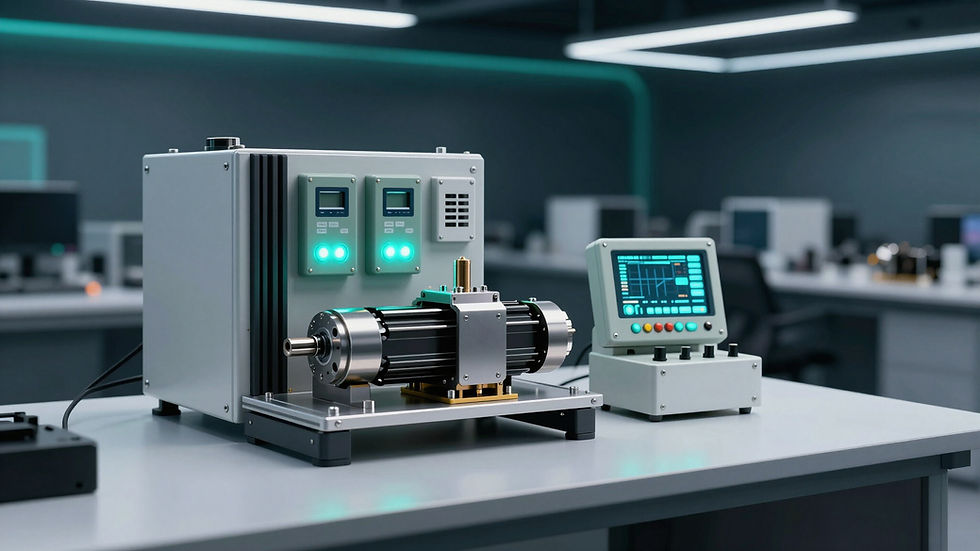
Stepper Motor Control Kit
This kit provides an open and closed-loop digital motion platform for analyzing torque characteristics and step resolution. Students can experiment with half-stepping and micro-stepping routines, exploring the physics of resonance and step loss in digital actuators. It is a vital resource for robotics and CNC labs, helping students master the specific control requirements of discrete motion systems used in additive manufacturing and lab automation.

Inverted Pendulum System
The Inverted Pendulum is a benchmark for advanced control theory, studying non-linear dynamics and stabilizing inherently unstable systems. Students implement real-time state-space models to balance the pendulum vertically on a motorized carriage. This module is essential for engineering students interested in aerospace, self-balancing vehicles, and advanced robotics, as it challenges them to manage high-speed feedback with extreme precision in unstable process environments.

Magnetic Levitation System
This electromagnetic suspension apparatus demonstrates feedback control in frictionless environments. Students must develop algorithms to keep a magnetic object hovering at a precise height, compensating for magnetic flux non-linearities and ambient noise. It is an excellent platform for teaching advanced topics such as electromagnetic modeling and precision contactless positioning, making it useful for labs exploring magnetic bearings and high-speed maglev transportation concepts.

Temperature Control Trainer
The Temperature Control Trainer is a thermal process plant used to demonstrate PID heating and cooling curves. It models common industrial issues such as thermal lag and transport delays, teaching students how to compensate for slow-moving process variables. This unit is essential for industrial engineering labs, providing a practical foundation for anyone entering sectors like food processing or materials manufacturing where precise thermal management is vital for product quality.

Twin Rotor MIMO System
The Twin Rotor MIMO system is a complex 2-degree of freedom flight simulator designed for multi-input multi-output control analysis. Students study the cross-coupling effects between horizontal and vertical rotors, implementing sophisticated decoupling algorithms. This is a critical apparatus for aerospace and advanced control labs, providing a practical laboratory equivalent to helicopter avionics and stabilizing platforms where multi-variable forces must be managed simultaneously.